Contraception Doesn’t Work?
What Russian Schoolgirls Are Being Taught and Why Their Parents Are Leaving

In a ninth-grade classroom in St. Petersburg, a priest from the local eparchy placed a crown on a student’s head, then explained that losing one’s chastity was comparable to that crown falling into mud. Students received badges reading “For a Chaste Lifestyle.” One girl, quoted afterward by the eparchy’s own press service, offered the takeaway: “I learned that contraception doesn’t work. My thoughts: I will be a virgin until marriage.”
The lesson took place in a public school, during school hours, as part of a wave of Church-led interventions that has accelerated sharply since early 2025. A Vërstka investigation published in March 2025 documented over 60 such lectures on chastity conducted by priests, nuns, abbesses, and eparchial staff in schools across 28 regions, including occupied Crimea and Donetsk. These lectures run parallel to a new federal curriculum, Семьеведение (Family Studies), whose official purpose is to instill “pro-family attitudes” such as marriageability, large families, and chastity. Together, they constitute the educational upstream of Russia’s accelerating abortion restriction apparatus. And they are part of a broader ideological transformation of Russian schools since 2022 that has driven a growing number of parents to withdraw their children entirely, a quiet exodus the state is now moving to close off.
Curriculum and Lectures
In August 2024, the Institute for Strategy of Education Development published a formal curriculum for Семьеведение as a 34-hour course for grades 5–9. The stated goal of instilling the values of marriageability, large families, and chastity is listed as curricular outcomes for children as young as ten. Piloted in 42 regions during 2024–2025, the course expanded to every Russian school for 2025–2026. Duma Deputy Nina Ostanina, chair of the Committee on Family Protection and co-author of the textbooks, has called for making it formally compulsory. An earlier teacher’s edition invites students to consider how the rules of the Domostroi, the sixteenth-century Russian household manual prescribing patriarchal family governance, might be applied to modern life.
Where Семьеведение represents the institutional channel, the ROC chastity lectures represent something less mediated. Corroborated by Glasnaya and the Moscow Times Russian Service, the Vërstka investigation found Church representatives operating directly inside schools with administration cooperation, some sessions restricted to female students. In Dzerzhinsk, a six-lecture course told schoolgirls femininity consists of two elements: motherhood and chastity. In Mari El, a priest’s wife told girls that “ancient tracts” teach that “chaste virgins and wives of virtue hold a mystical power whose energy brings might to the state.” In Chuvashia, students were told 120 years ago there were almost no divorces because no one engaged in premarital sex, omitting that early twentieth-century Russian women had virtually no legal right to leave their husbands.
Chastity Within the Broader Apparatus
Семьеведение and the chastity lectures represent one layer of a comprehensive ideological transformation underway since September 2022. “Conversations About Important Things” (Разговоры о важном) launched that month with Putin personally conducting the inaugural lesson: weekly Monday sessions covering the “special military operation,” Crimea’s “reunification,” and military heroism. Though classified as extracurricular, they are effectively mandatory: a private college in Novosibirsk was fined 50,000 rubles for refusing and forced to close. By September 2025, the sessions expanded to kindergartens targeting children as young as three.
A new unified history textbook by Putin aide Vladimir Medinsky, reaching classrooms in September 2023, describes Ukrainian independence as “so-called” and frames the invasion as necessary to prevent “the end of civilization.” In September 2024, “Fundamentals of Security and Defense of the Motherland” (ОБЗР) introduced mandatory weapons training including Kalashnikov rifles, RPG-7 grenade launchers, Dragunov sniper rifles, hand grenades, and drone operation starting in the eighth grade. The Movement of the First (Движение первых), created at Putin’s initiative in December 2022, has enrolled 13.8 million children with a goal of 72% of all five-to-nineteen-year-olds by the end of 2024. The state’s budget for patriotic education rose nearly tenfold between 2022 and 2024 to 46 billion rubles. Meanwhile, 325 people - 190 students and 135 teachers - have been involved in politically motivated criminal cases since 2009, with 161 cases in 2022–2024 specifically.
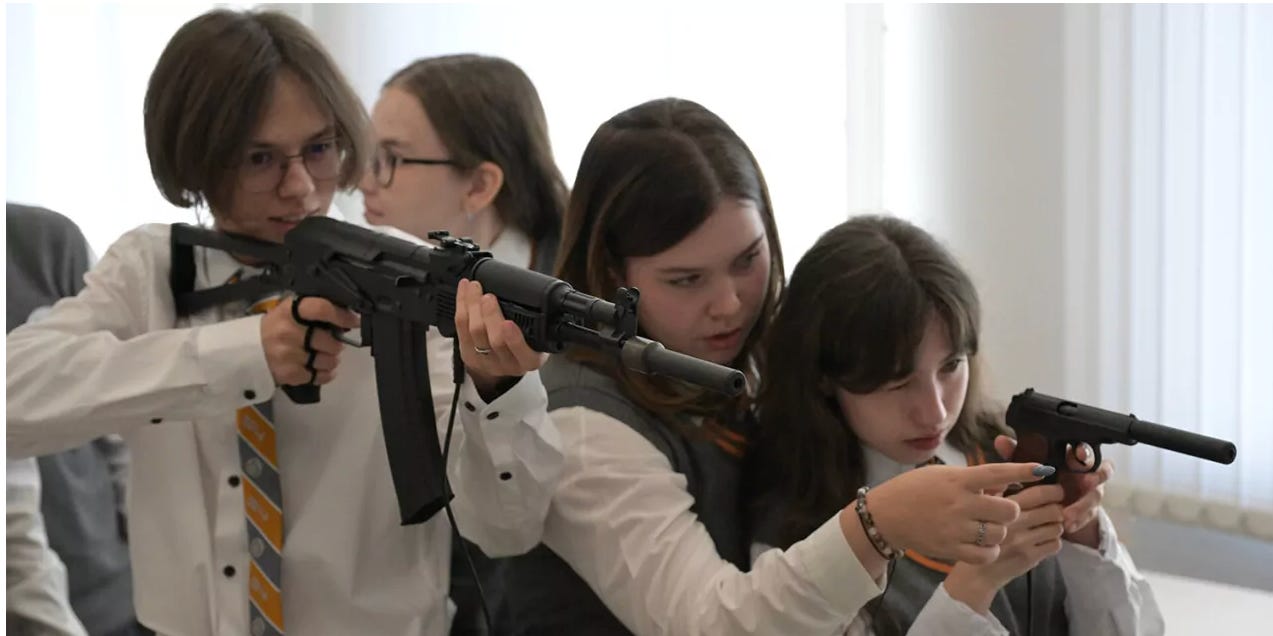
For parents, Семьеведение was not the first imposition but another in a sequence Moscow Times columnist Dima Zitser describes as successive red lines: “first came flag ceremonies, then lessons on ‘what matters,’ then Ukraine war veterans teaching in classrooms, now classes on Russia’s spiritual foundation and special destiny.”
The Connection
The chastity lectures and Семьеведение operate within a policy architecture whose other components are explicitly coercive. Since 2023, 30 regions have enacted laws criminalizing “inducement to abortion.” The first conviction came in December 2025: a man fined 5,000 rubles for offering to pay for his girlfriend’s abortion. According to the Patriarchal Commission on Family, 852 private clinics have ceased providing abortions since February 2023. At the January 2026 Christmas Parliamentary Meetings, Patriarch Kirill called for a complete federal ban on abortions in private clinics.
The upstream-downstream architecture is straightforward: it shapes sexual behavior through school programming while restricting abortion access downstream. Duma Deputy Ostanina is the same official who declared Russia needed a “special demographic operation, just like a special military operation.” The phrase had already entered circulation a week earlier when Albert Bakhtizin, director of the Central Economics and Mathematics Institute of the Russian Academy of Sciences, told Interfax that “the country needs a special demographic operation, no less. Chastity education and clinic closures are becoming complementary components of the same demographic apparatus.
A Quiet Exodus
For a growing number of parents, the response has been withdrawal. As of 2025–26, 99,400 children are officially registered for семейное образование (family education). That’s a 16.8% increase over the previous year.
Moscow City Pedagogical University researchers analyzing the Ministry of Education statistics found that the number of children educated outside schools grew tenfold in eight years, from 17,900 in 2016 to 174,700 in 2023, reaching 1% of all students. Official data shows family education grew 12.4 times between 2016–17 and 2023–24. In St. Petersburg alone, 301 unlicensed “family schools” - parent cooperatives hiring tutors - operate in a legal gray zone.
Two distinct populations use the same legal framework: conservative families seeking faith-based education, and liberal families fleeing propaganda. No survey isolates anti-propaganda motivation, openly stating such reasons risks prosecution, but the growth curve accelerated precisely as propaganda intensified. One parent told Meduza in 2023: “I went to a meeting for parents in the spring and realized that I couldn’t send my children to that school.” The strategies of families who remain in school form a spectrum: negotiating with sympathetic teachers, “reprogramming” at home, or teaching children doublethink.
The state has noticed. In January 2026, Duma Deputy Ilya Volfson proposed requiring inter-agency commission approval for homeschooling transitions, mandatory biannual attestation, and limiting eligibility. Tatarstan has become the epicenter of pushback, with local education minister Ildus Khadiullin calling the growth of the practice “unforgivable” and damaging to children’s socialization while it grew by 50% as of August 2025. Local Telegram channels have reported police arriving at night at a homeschooling family’s door, courts ruling against mothers, and officials discussing abolishing family education. Russian law currently protects homeschooling; Article 17 of Federal Law No. 273-FZ explicitly establishes family education as a right. But the Volfson proposals and the Tatarstan model preview what a more restrictive regime could look like.
What Distinguishes This
The Семьеведение curriculum frames chastity as a policy tool for national demographic recovery, converting intimate decisions into matters of state interest. The ROC lectures enter public schools as programming coordinated with administrations, in institutions where students cannot opt out. Both operate alongside weapons training, historical revisionism, and a state youth movement aiming to capture the vast majority of Russian children.
Whether teaching chastity to fifth-graders will raise Russia’s fertility rate is a question the curriculum’s architects have not seriously engaged. What both programs accomplish is the normalization of state interest in citizens’ most intimate decisions from childhood onward, delivered through an architecture where the boundaries between ministry, church, and school have become impossible to identify. The classroom, like the clinic, has become a site of demographic intervention. For a growing number of families, the only available response is to leave it.